April 17, 2013


May 11, 2012
Citrix Boosts VDI Offering With Products, Acquisition and Details at Cloud-based Future
Citrix Systems is upgrading XenDesktop, acquiring Virtual Computer, introducing a new type of hardware-assisted thin client and initiating a cloud project in an effort to make its virtual desktop infrastructure offering more attractive.
The company is focusing on that effort at its Synergy user conference, which opened Wednesday and runs through Friday in San Francisco.
Desktop virtualization is one of the main themes at the event as the company provides its take on how enterprises can best deal with the challenge of managing desktops and applications in a new mobile-centric world.
Project Avalon will allow enterprises to run any Windows application or desktop in a public, private or hybrid cloud. The desktop or client can be delivered across any network, to any device, according to Citrix.
"Moving to a cloud architecture enables us to simplify the installation and expansion of [virtual desktop deployments] and how people can flexibly manage and optimize the utilization of those resources. It also adds a layer of automation," said Bob Schultz, vice president and general manager of Citrix's desktop and applications business.
The platform will run on an integration of XenDesktop and Apache CloudStack, on which Citrix has developed its own CloudPlatform. The combination enables multitenant installations across multiple locations that will be able to scale to over 1 million users, according to Citrix.
The transition to cloud-based desktops and applications isn't going to be a magical moment where enterprises move everything in one swoop, according to a blog post by Citrix's Joe Vaccaro, who oversees strategy and development for desktop and application delivery in the cloud.
Instead, it will be process where enterprises place new desktop and application groups in an on-premise private cloud and possibly look at getting extra capacity from a public cloud for their desktop and app needs, Vaccaro said.
The best way to get started is to continue deployments of XenApp 6.5 and XenDesktop 5.6, and use CloudStack, said Schultz.
When Project Avalon will arrive remains to be seen. Citrix isn't announcing availability, it said.
On Wednesday, Citrix also announced the acquisition of Virtual Computer, which will help Citrix improve its XenClient hypervisor, and create the Citrix XenClient Enterprise edition, it said.
XenClient is a so-called bare-metal hypervisor for desktop virtualization. The technology holds the promise of allowing desktop virtualization to work without a network connection and letting the IT department issue laptops that come with one OS for corporate use and one for personal use.
Terms of the acquisition were not disclosed.
While Project Avalon and the acquisition of Virtual Desktop is about Citrix's future, the company also made announcements that will have a more immediate effect for users.
Working with partners such as Hewlett-Packard, Citrix is announcing a new generation of thin clients that are based on the company's HDX System-on-Chip initiative, which was announced last October.
By using optimized hardware-based acceleration rather than decoding and rendering virtual desktop traffic on a general purpose processors in software, these clients can deliver the user experience of thin client hardware costing twice as much or more while reducing power consumption, heat, and footprint, according toa Citrix blog post.
Devices based on the initiative still run a Receiver client in an embedded OS, it said.
Besides Hewlett-Packard, hardware vendors such as Atrust, Centerm, NComputing and ThinLinX are also onboard, Citrix said. The thin clients are compatible with both XenDesktop and VDI-in-a-Box.
In June, Citrix will also start distributing XenDesktop 5.6 Feature Pack 1, which will simplify printing; use compression technology to reduce bandwidth requirements for 3D content from CAD/CAM or GIS applications; and process voice and video locally. The latter will, for example, work with Cisco System's VXI Unified Communications and Lync 2010 from Microsoft.
Send news tips and comments to mikael_ricknas@idg.com
Tablet Outlook 2012: What's Expected from Apple, Google, Microsoft
 Summer 2012 promises to be the season of tablet experimentation on a grander scale than ever.
Just about every tablet maker, including Apple, is rumored (or expected) to announce (or launch) a new tablet version within roughly the next four months. The devices are likely to be smaller in the case of Apple and bigger in the case of Amazon.
Google is expected to announce an inexpensive tablet with hardware maker Asus at the Google I/O conference in late June, while a Windows RT tablet from Microsoft and new-found partner Barnes & Noble could be on tap for late summer or fall.

 Click to ZoomWith so many different reports of new tablets surfacing, it's time to take stock of what's coming.
To begin, here are some general themes seen by analysts for what's coming in the next quarter:
Apple will grow stronger, even with new competitors like Microsoft. That's not a hard conclusion to reach, since Apple took 59% of the global tablet market in 2011, according to IDC, which expects Apple to dominate the tablet market through 2016, at least.Google will attempt to regain control of a pure Android tablet. Having seen Amazon, with its Kindle Fire, and Barnes & Noble, with the Nook tablet, selling forked versions of Android that lessen dependency on Google services and apps, the company will want to step up its control over the mobile operating system it created.More vendors will lower the prices of their tablets to compete with the $200 Kindle Fire and the Nook.More LTE-based tablets will emerge, offering faster wireless connections, even though customers currently prefer Wi-Fi-only models. A move to LTE will become even more likely once wireless carriers announce shared data plans, possibly this summer, that enable users to share smartphone and tablet data, possibly even across a workgroup or a family.Tablet sizes will vary widely, with touchscreens ranging from 7 to 13 inches diagonally, although a 10-in. form factor will be dominant. The iPad has a 9.7 in. screen.Here's what's on tap for this summer, in order of likely timing:
This month: Barnes & Noble and Amazon have already kicked off new TV ad campaigns for their current Nook Tablet and Kindle Fire models -- both of which have 7-in. touchscreens. They're hoping to appeal to people shopping for graduation gifts and to clear out inventory to make room for forthcoming models, analysts said.
 May or June: Amazon is expected to launch a tablet that's larger than its 7-in. Kindle Fire, but IDC analyst Tom Mainelli said it's not clear whether it will be a 9.7-in. or 8.9-in. device.
Late June: In an announcement that will probably take place at Google I/O, Google is expected to unveil a $200 tablet called Google Play that will run Android 4.0 (Ice Cream Sandwich) using a Tegra 3 quad-core processor.
The Google Play would be built by Asus, possibly co-branded with Google or purely branded as a Google product. Its biggest distinction would be that it runs plain vanilla Ice Cream Sandwich, not the versions of Android seen in the Nook and the Kindle Fire.
August: Dominant tablet maker Apple is expected to launch a smaller version of the iPad, according to reports in Digitimes and elsewhere on Wednesday. These reports say the smaller iPad will be a 7-in. model, although Mainelli said it could be 7.8 in., just shy of two inches smaller than the current iPad.
Mainelli said the reports of a smaller iPad have credence. A smaller iPad, he said, "will help Apple gain traction in regions [like Japan] where the 9.7-in. tablet has been slower to take off because consumers think it's too big."
A smaller tablet would also enable Apple to offer a tablet at a lower price, possibly in the range of $299 to $349, while still maintaining to its historically high profit margins, Mainelli added.
"Once Apple owns every price point, from $299 to $829 [for the 64GB new iPad with Wi-Fi and 4G LTE connectivity], it's going to be very, very difficult for Android tablets and Windows 8 and Windows RT tablets to compete with Apple," Mainelli said.
Even today, Apple's prices have come down, with the 16GB, Wi-Fi-only iPad 2 model selling at $399, Mainelli added. That level of pricing is attractive to "cash-strapped consumers as well as educational buyers, who are embracing the iPad in a major way in some regions," he said.
 By late summer, Microsoft is expected to make clear its plans for Windows 8 and Windows RT tablets, even if the devices don't ship until fall or later. Any announcement on that topic is expected to clarify whether Barnes & Noble and Microsoft, who recently became partners, will cooperate on a Windows tablet.
Also this summer, wireless carriers, such as Verizon Wireless and AT&T, are expected to provide more options for data packaging, where one monthly data plan would cover service across multiple devices, such as a tablet with a smartphone. That kind of data packaging could open up interest in LTE-ready tablets, offering the promise of faster video streaming and browsing.
Mainelli said Verizon is reported to be the first to offer such a data package. An AT&T executive at the CTIA conference also said tablets that combine Wi-Fi and LTE for an affordable price are in the planning stages. AT&T sold out of its Pantech Element tablet, a Wi-Fi-and-LTE device with a price tag of $399. Today, an  iPad with LTE and Wi-Fi costs $130 more than a Wi-Fi-only model, not including the cost of a monthly service plan.
"Once carriers start offering the ability to use one data plan across multiple devices, then LTE on tablets become very interesting," Mainelli said.
In addition to whatever new tablets may be announced in the coming months, there are other notable tablets that we know will begin shipping over the summer. They include the Toshiba Excite, the largest tablet at 13.3 in. and 2.2 lbs. It will go on sale June 10, starting at $650 for a 32GB model. It runs Android 4.0 and uses an Nvidia Tegra 3 quad-core processor.
While it's uncertain how well such a large tablet will sell, analysts agree that the Excite 13 is a sign of a fairly staggering amount of diversity in the tablet market.

For more enterprise computing news, visit Computerworld. Story copyright © 2011 Computerworld Inc. All rights reserved.
May 10, 2012
Microsoft's Purported Windows RT Firefox Ban: A Quick Explainer
 Microsoft is giving Internet Explorer an unfair technical advantage in Windows RT (Windows 8 for ARM-based devices) that is the "first step toward a new platform lock-in," according to the Mozilla Foundation. The group behind the open source Firefox browser is complaining that Internet Explorer will be the only browser on Windows RT allowed to run in the traditional desktop environment.
That means IE will be able to integrate with Windows RT in ways that competing browsers can't, giving Microsoft's IE a leg up in terms of speed, stability and security, Mozilla’s general counsel, Harvey Anderson, said in a blog post.
Mozilla also suggests that Microsoft may be flirting with antitrust violations by freezing out other browsers from Windows RT, echoing issues that sparked the software giant's antitrust battle with the U.S. government more than a decade ago.
What is Windows RT?Windows RT is the version of Windows 8 designed primarily for ARM-based single-panel touch tablets, but is also expected to arrive on lightweight laptops. Windows RT will have two user interfaces: a touch-friendly Metro-style interface and a traditional Windows 7-like desktop. This is similar to Windows 8 for x86 chips. The difference, however, is how Windows 8 and Windows RT handle applications.
How Does Windows 8 Handle Apps?Windows 8 will have three application types: Metro, classic desktop, and Metro-style enabled desktop browsers (MEDB). Mozilla is already working on creating an MEDB version of Firefox for Windows 8 that allows users to install the browser once and run it on both the Metro and desktop interfaces. However, Windows 8 will only allow your system's default MEDB to run in the Metro interface. In other words, you can't run Firefox in Metro if IE is your default browser.
What About Windows RT? Windows RT will focus on offering Metro-style apps optimized for touch devices and connected to cloud services such as SkyDrive. But there will also be a traditional desktop to run programs such as Microsoft Word, Excel, PowerPoint and OneNote (all four are bundled with Windows RT), Windows Explorer and the desktop version of IE. Legacy Windows desktop apps will not run on Windows RT.
The problem is that Windows RT does not have an equivalent MEDB class of apps, according to Mozilla's Asa Dotzler. MEDB apps on Windows 8 can access powerful application programming interfaces (APIs) that browsers need "to deliver modern capabilities and performance," Dotzler wrote in a blog post. Third-party browsers on Windows RT will not be getting the same access to those APIs as IE will have, according to Mozilla. "Without that access," Dotzler says, "no other browser has a prayer of being competitive with IE."
What is Microsoft Saying?Microsoft has not responded to PCWorld's request for comment.
Who Cares About Windows 8 for Tablets Anyway?It's not clear if ARM-based Windows devices are going to be an important factor when Windows 8 starts rolling out this year. Previous reports claimed that five or fewer ARM-based Windows RT devices would be available at launch. And market research firm NPD DisplaySearch predicts that Windows RT tablets will grow slowly during the first five years, going from 1.5 percent of all tablets sold worldwide to 7.5 percent by 2017.
So whether Mozilla will miss out by not being on equal footing with Internet Explorer on Windows RT is up for debate. Nevertheless, Microsoft's actions, if accurate, could give the company an unfair advantage if Windows RT becomes a popular option for consumers and device makers. And Microsoft's actions could bring up antitrust problems for the company in the U.S. and Europe, according to Mozilla.
The irony, of course, is that Microsoft's original antitrust problems in the late 1990s and early 2000s were sparked by how the company bundled Internet Explorer with Windows. But until Microsoft has had a chance to explain don't count on history repeating itself just yet.
Connect with Ian Paul (@ianpaul) on Twitter and Google+, and with Today@PCWorld on Twitter for the latest tech news and analysis.
May 9, 2012
Wrapp up free gift cards for Facebook friends
APPOLICIOUS ADVISOR RATING:
4 of 5 bars PRICE: FreeTASTY: See all of your Facebook friends’ upcoming events, such as birthdays.BUMMER: Your friends will have to authorize Wrapp to use their Facebook accounts to gain access to your gift.COOL: Give free $5 gifts to popular retailers or purchase higher amounts.Wrapp is a great app that’s likely to be passed over by many users simply for its connection to Facebook. The app for iPhone and iPod Touch integrates with your Facebook account, allowing you to celebrate your friends by sending them gift cards—for free. Yes, that’s right. Free money.
In the app you’ll be able to see your friends’ upcoming birthdays—including ages, where available—as well as a directory of all of your Facebook friends. Want to do something nice for them? Simply tap their name and then select an item, such as a $5 gift card to Gap, H&M or Sephora, all of which are free for you to choose. If you want, you can pay to increase the value of the gift, too.
Gifts can be sent by text, email or posted to your friend’s Facebook wall. Although the latter makes sense given the Facebook integration, I’d likely opt for the other two methods, lest your gift be lost in spam.
Wrapp’s biggest downside is that it requires your friend to allow the app access to their Facebook account in order to see and redeem your gift. Considering I’d never heard of the service before today—and the wealth of Facebook scams in existence—it’s likely that many of your gifts could go unclaimed. Telling your friends about the service might ruin the surprise, but it’s probably the only way to ensure your gift doesn’t go unnoticed.
Wrapp supports gifts in the United States, UK, Norway and Sweden.
Find great games for iOS here
Payday loan firm Wonga to lend to small businesses
LONDON (Reuters) - British online payday loans provider Wonga.com launched a credit service for small businesses on Monday, aiming to fill a gap in the market left by banks who have been hamstrung by tight lending conditions imposed since the credit crunch.
Wonga, which has made 4 million short-term loans to consumers since its launch in 2007, will offer small businesses loans of 3,000 to 10,000 pounds ($4,800 to $16,200) for periods of between one and 52 weeks.
Interest rates will be fixed at between 0.3 and 2 percent per week, depending on how risky the loan is judged to be.
Wonga uses automated risk-processing technology to give near-instant answers to online applicants, and turns down about two-thirds of applications.
It now aims to export its more popular features, including the simple application screen featuring sliders that can be dragged to the desired amount to be borrowed and repayment period, to the business world.
"We wanted it to have all the characteristics that people positively associate with Wonga in terms of transparency, simplicity, ease of use, speed ... and we wanted to bring that to small business," said Chief Executive Errol Damelin.
Wonga's business has boomed during the downturn as cash-strapped consumers who found it hard to obtain short-term credit elsewhere turned to it for loans of up to 1,000 pounds to tide them over for up to a month.
The company has been criticized for charging too much interest - it charges simple interest to consumers of just under 1 percent per day - and for targeting the vulnerable.
But Wonga says its transparency, strict acceptance criteria and low default rates, which are in the mid-single digits, show it is a responsible lender.
Because it does not take deposits, Wonga operates under a consumer-credit license, not a banking license, meaning it is not subject to the capital requirements that are currently preventing banks from lending more.
"What became crystal clear to us a year or so ago was that small businesses had maybe even more need than individuals for solving short-term cash-flow problems," Damelin, who is also one of the company's two founders, told Reuters in an interview.
"For owner-operated businesses, capital is their oxygen. That's what they live and breathe and that's what's gives them the opportunity to stay in business and grow their businesses and employ people and help the economy recover."
Unlike the consumer-loan application process, which instantly displays the total cost of borrowing, Wonga for Business will have no instant decisions or predetermined interest rates because of the larger sums at stake and variety of risk factors.
Applicants must provide information about their company and its directors, who personally guarantee the loan. Wonga says the application process can be completed in 12 minutes, and money can be transferred to the business in as little as half an hour.
Wonga is the market leader for short-term, unsecured loans that can only be obtained online. It currently operates in Britain but is considering entering other markets such as Canada and South Africa in time.
Wonga's backers include Accel Partners, Balderton Capital, Greylock Partners, Oak Investment Partners and the Wellcome Trust. The company raised 73 million pounds in fresh capital a year ago.
($1 = 0.6189 British pounds)
(Reporting by Georgina Prodhan; Editing by Hans-Juergen Peters)
May 8, 2012
AT&T barges into home security and automation
NEW YORK (AP) — AT&T Inc. will start selling home automation and security services nationwide, taking on incumbents led by Tyco International Ltd.'s ADT.
The installations and services will be sold in AT&T stores, starting with a trial this summer in Dallas and Atlanta.
Several of AT&T's competitors, including cable TV company Comcast Corp. and phone company Verizon Communications Inc., have ventured into the home automation and security field. Dallas-based AT&T is showing more ambition with its stated goal of selling nationwide, rather than sticking to its landline service territory, as Verizon does.
Steven Winoker, an analyst at Sanford Bernstein, said about 23 percent of U.S. homes have security systems, so there's plenty of room to grow. Even fewer have automation systems for controlling appliances, lights, heating and cooling.
The biggest player in the field is ADT, but it has only 25 percent of the market. Many smaller companies make up the rest, according to Winoker.
It's a very profitable business, Winoker said, but it's not big enough to significantly affect the earnings of a company of AT&T's size even if it's successful, given that it's a relatively small market.
AT&T's technology comes from Xanboo, a company it bought in late 2010. Its central control panel can connect wirelessly with cameras, thermostats, appliance controls, lights and sensors for doors, windows, smoke and carbon monoxide. Through the panel, home owners can then control their home from their cellphones.
It's highly recommended that the control panel is connected to wired broadband, but it doesn't have to be service through AT&T, said Glenn Lurie, AT&T's president of emerging devices. As a backup, the panel can connect to AT&T's wireless data network.
AT&T didn't say what its services would cost.
AT&T made its announcement on the eve of the U.S. cellphone industry's annual trade show, which starts Tuesday in New Orleans.
3D Printing Gives Amputees Custom-Designed Legs [VIDEO]
A San Francisco company called Bespoke Innovations is using 3D printing and modeling technology to give prosthetic limbs new life as custom-designed, wearable pieces of art.
[More from Mashable: Stunning 3D-Printed Guitars Will Blow You Away [PICS]]
Here's how it works: First, the company 3D scans both customers' natural and prosthetic legs. A 3D computer model is created, maintaining as body symmetry as possible between the two limbs. Then, the client begins directing the customization process of his or her new fairing. (A fairing is the prosthetic covering for an artificial limb.) Customers can choose from a range of patterns, templates and materials, and Bespoke is preparing to introduce an online tool for more experimentation. Finally, the specially-designed end result is produced using 3D printing technology.
SEE ALSO: You’ll Download Physical Objects Sooner Than You Think, Thanks to Kids Like These[More from Mashable: Shapeways CEO Will Discuss the Future of 3D Printing at Mashable Connect]
It all adds up, Bespoke says, to prosthetic limbs that actually reflect their users' personalities and tastes. The custom fairings cost between $4,000 and $5,000, according to the company's website.
“We are working on this guy from Israel right now,” co-founder Scott Summit tells Bloomberg Businessweek. “We are designing a Porsche 911 aesthetic for him. It’s a really classic design with clean lines and timeless detailing. We just did three other legs for three guys in Germany, all to reflect their very distinct personalities.”
Do you think this is a cool use of 3D printing technology? Where else do you want to see 3D printing tech applied for innovation? Let us know in the comments.
Thumbnail image courtesy Bespoke Innovations
This story originally published on Mashable here.
May 7, 2012
'Avengers' smashes record: $200.3 million debut
LOS ANGELES (AP) — Hulk, smash.
That's what Captain America tells the Incredible Hulk to do in "The Avengers," and that's what the Marvel Comics superhero mash-up did at the box office, smashing the domestic revenue record with a $200.3 million debut.
It's by far the biggest opening ever, shooting past the previous record of $169.2 million for the debut of last year's "Harry Potter" finale.
"The Avengers" added $151.5 million overseas over the weekend to bring its total to $441.5 million since it began opening internationally a week earlier.
That raised the film's worldwide haul to $641.8 million in barely a week and a half, more than its Marvel superhero forerunners "Iron Man," ''Iron Man 2," ''Thor" and "Captain America" took in during their entire runs.
If distributor Disney's domestic estimate Sunday holds when the final weekend count is released Monday, "The Avengers" would be the first movie ever to haul in $200 million in a single weekend.
While the number could dip below $200 million come Monday, Disney spent the weekend revising its forecasts upward as business kept growing.
"There aren't even words, to be honest. I'm running low on double takes. Every time we looked at a number, it just got bigger than what we could have hoped for in the best-case assumption," said Dave Hollis, Disney's head of distribution. "With this film, this weekend, anything is possible."
"The Avengers" started with solid midnight crowds Friday, though nowhere near a record. Then it did $80.5 million for the full day Friday, second only to the "Harry Potter" finale's $91.1 million first day.
Revenues held up much better than expected with $69.7 million Saturday, and Disney estimated that the film would bring in $50.1 million more on Sunday.
The record weekend was the culmination of years of careful planning by Marvel Studios, which has included teasers for an "Avengers" dream team collaboration in its solo superhero adventures.
Directed by Joss Whedon ("Buffy the Vampire Slayer"), "The Avengers" features Robert Downey Jr. as Iron Man, Chris Evans as Captain America, Chris Hemsworth as Thor, Mark Ruffalo as the Hulk, Scarlett Johansson as Black Widow, Jeremy Renner as Hawkeye and Samuel L. Jackson as Nick Fury.
A $200 million total for every movie in release is considered a great weekend for the business as a whole, so "The Avengers" redefines the standards for a blockbuster debut.
"If 'The Avengers' is any indication, we're going to see a leap rather than a gentle little nudge into new territory, and the lineup is there to justify it going forward," said Greg Foster, chairman and president of the huge-screen IMAX cinema chain.
Crowds were so anxious to see the film on IMAX's giant screens that Foster said the company had only one problem: it ran out of seats to sell.
Overall domestic revenues came in at $248 million, climbing 49 percent compared to the same weekend last year, when "Thor" opened with $65.7 million, according to box-office tracker Hollywood.com. "The Avengers" accounted for four-fifths of the weekend's domestic receipts.
Hollywood launched a potentially record-shattering summer with a vengeance, "The Avengers" landing as just the first of three huge superhero tales that highlight a lineup filled with other blockbusters in the making.
"The Amazing Spider-Man" follows on July 3 and "The Dark Knight Rises" wraps up the current Batman series on July 20.
Until the "Harry Potter" finale, 2008's "The Dark Knight" had held the revenue record with a $158.4 million debut. Before that, the record-holder was 2007's "Spider-Man 3" with $151.1 million.
So anticipation for those two films could rival that of "The Avengers."
As admission prices rise, Hollywood's record-breakers often take in more money but sell fewer tickets than previous blockbusters. But "The Avengers" took in so much money that it's the undisputed champ among debuts.
Based on average admission prices the years they were released, "The Dark Knight" and "Spider-Man 3" had led with about 22 million tickets sold each over opening weekend. Today's average prices put "The Avengers" tally at around 25.6 million tickets sold.
Along with the superhero films, Hollywood's summer lineup includes the action tales "Men in Black 3," ''G.I. Joe: Retaliation," ''Battleship," ''Total Recall" and "Prometheus," director Ridley Scott's return to the sci-fi territory of his horror hit "Alien."
Big family fare includes the animated adventures "Brave," from "Toy Story" creator Pixar Animation, and the sequels "Ice Age: Continental Drift" and "Madagascar 3: Europe's Most Wanted."
The comedy lineup features Adam Sandler's "That's My Boy," Will Ferrell's "The Campaign" and Sacha Baron Cohen's "The Dictator."
"'The Avengers' kicks off what looks to me to be the summer box-office equivalent of the 100-year flood," said Hollywood.com analyst Paul Dergarabedian. "This is perhaps the most perfect summer lineup in box-office history."
Estimated ticket sales for Friday through Sunday at U.S. and Canadian theaters, according to Hollywood.com. Where available, latest international numbers are also included. Final domestic figures will be released Monday.
1. "The Avengers," $200.3 million ($151.5 million international).
2. "Think Like a Man," $8 million.
3. "The Hunger Games," $5.7 million ($4.3 million international).
4. "The Lucky One," $5.5 million ($5.5 million international).
5. "The Pirates! Band of Misfits," $5.4 million ($2.6 million international).
6. "The Five-Year Engagement," $5.1 million ($2.3 million international).
7. "The Raven," $2.5 million.
8. "Safe," $2.47 million ($2.2 million international).
9. "Chimpanzee," $2.4 million.
10. "The Three Stooges," $1.8 million.
___
Estimated weekend ticket sales at international theaters (excluding the U.S. and Canada) for films distributed overseas by Hollywood studios, according to Rentrak:
1. "The Avengers," $151.5 million.
2. "American Reunion," $34 million.
3. "Battleship," $11 million.
4. "Jannat 2," $6.1 million.
5. "The Lucky One," $5.5 million.
6. "The Hunger Games," $4.3 million.
7. "Titanic" in 3-D, $4.2 million.
8. "Mirror Mirror," $3.7 million.
9. "As One," $3.6 million.
10. "Thermae Romae," $2.9 million.
___
Online:
http://www.hollywood.com
http://www.rentrak.com
___
Universal and Focus are owned by NBC Universal, a unit of Comcast Corp.; Sony, Columbia, Sony Screen Gems and Sony Pictures Classics are units of Sony Corp.; Paramount is owned by Viacom Inc.; Disney, Pixar and Marvel are owned by The Walt Disney Co.; Miramax is owned by Filmyard Holdings LLC; 20th Century Fox and Fox Searchlight are owned by News Corp.; Warner Bros. and New Line are units of Time Warner Inc.; MGM is owned by a group of former creditors including Highland Capital, Anchorage Advisors and Carl Icahn; Lionsgate is owned by Lions Gate Entertainment Corp.; IFC is owned by AMC Networks Inc.; Rogue is owned by Relativity Media LLC.
February 19, 2012
Nikon Announces D800 Full-Frame DSLR Packs 36 Megapixels Camera.
With a 36-megapixel full-frame sensor, the $3000 Nikon D800 is built for huge prints, aggressive cropping, fashion shoots, and fat wallets.
 Nikon today announced its second new full-frame DSLR of the year, the Nikon D800, which offers the same-size sensor as the Nikon D4 announced at CES 2012. The Nikon D800 will sit below the D4 at the high end of Nikon's DSLR line, offering more than twice the pixel density of the top-of-the-line D4. Nikon says that the D800 will eventually replace the Nikon D700 in the company's prosumer DSLR lineup, and that the new camera offers the highest-resolution Nikon sensor yet.
The D800's FX-format full-frame sensor captures 7360-by-4912-resolution images (36.15 megapixels), and its size, in-camera features, and target buyer all differ slightly from those of the 16-megapixel Nikon D4. Whereas the D4 is geared more toward high-speed shooting and low-light performance, the Nikon D800 puts image resolution front and center with its 36.3-megpixel sensor. Nikon says the D800 is built with wedding photography, portraits, and fashion spreads in mind. The combination of pixel density and sensor size should make the D800's output about as crop- and billboard-friendly as it gets outside a medium-format camera.
The D800's image resolution translates into a slower burst-shooting speed at full resolution when compared to the D4 (the D800 snaps 4 frames per second versus the D4's continuous shooting speed of 10 fps) and an ISO range that isn't quite as expandable as the one found in the D4 (the D800 caps out at ISO 25,600, while the D4 is expandable to a whopping ISO 204,800). Both new DSLRs offer a hot shoe for external flashes; but unlike the D4, the Nikon D800 also has a built-in pop-up flash, which can serve as a commander flash to control external Speedlight flashes. The D800 is also significantly smaller than the D4, at 5.7 inches wide, 4.8 inches tall, and 3.2 inches deep, as compared to the D4's 6.3-by-6.2-by-3.6-inch frame.
In addition to the similar sensor sizes, the D800 and the D4 share a few notable similarities, as well: Both are built around Nikon's latest Expeed 3 image processor; both offer 91,000-dot color-matrix metering; both employ a 51-point autofocus system; and both feature a "Dual Live View" mode that retains manual exposure settings while toggling between still- and video-capture modes.
 The Nikon D800 looks as though it will be a popular DSLR for videographers ,thanks to manual exposure controls in video mode; 1080p recording at 30, 25, and 24 fps (as well as 720p video at 60 fps); and the ability to feed uncompressed video to a monitor or recording device via HDMI as it's being captured. A 3.5mm stereo mic jack supports recording audio with an external microphone, and the D800 offers the same in-camera audio monitoring and headphone jack as the D4.
In addition to the expected RAW mode, manual exposure controls, aperture-priority, and shutter-priority modes for a camera of its class, the D800 will have an automated HDR (high dynamic range) mode, automatic scene-recognition features, and an Active D-Lighting feature to bring out highlights in shadowy areas.
 To speed up transfers of bulky 36-megapixel image files and 1080p videos, the D800 has a high-speed USB 3.0 connector (which will also work with USB 2.0 cables at a slower transfer rate). Storage is handled by two separate card slots--one for SDHC/SDXC cards, and one for CompactFlash cards--and shooters can define target cards for photos and videos separately, set one of the cards as a backup drive, and automatically jump between storage cards without interrupting video recording if one of them fills up.
The Nikon D800 is due in March at $3000 for the body only--about half the price of the higher-end Nikon D4. A second version of the D800, called the Nikon D800E, will also arrive in April. The D800E will eliminate the D800's integrated low-pass filter; Nikon says the filter-less D800E will provide a further boost to detail and image resolution at the expense of a visible moire effect in some images. The Nikon D800E will be priced at $3300 for the body only.
Source : http://www.pcworld.com

The D800's FX-format full-frame sensor captures 7360-by-4912-resolution images (36.15 megapixels), and its size, in-camera features, and target buyer all differ slightly from those of the 16-megapixel Nikon D4. Whereas the D4 is geared more toward high-speed shooting and low-light performance, the Nikon D800 puts image resolution front and center with its 36.3-megpixel sensor. Nikon says the D800 is built with wedding photography, portraits, and fashion spreads in mind. The combination of pixel density and sensor size should make the D800's output about as crop- and billboard-friendly as it gets outside a medium-format camera.
 |
In addition to the similar sensor sizes, the D800 and the D4 share a few notable similarities, as well: Both are built around Nikon's latest Expeed 3 image processor; both offer 91,000-dot color-matrix metering; both employ a 51-point autofocus system; and both feature a "Dual Live View" mode that retains manual exposure settings while toggling between still- and video-capture modes.

In addition to the expected RAW mode, manual exposure controls, aperture-priority, and shutter-priority modes for a camera of its class, the D800 will have an automated HDR (high dynamic range) mode, automatic scene-recognition features, and an Active D-Lighting feature to bring out highlights in shadowy areas.

The Nikon D800 is due in March at $3000 for the body only--about half the price of the higher-end Nikon D4. A second version of the D800, called the Nikon D800E, will also arrive in April. The D800E will eliminate the D800's integrated low-pass filter; Nikon says the filter-less D800E will provide a further boost to detail and image resolution at the expense of a visible moire effect in some images. The Nikon D800E will be priced at $3300 for the body only.
Source : http://www.pcworld.com
February 17, 2012
More US government websites hacked by Anonymous
LONDON (AP) — The hacking group known as Anonymous has claimed a new series of hacks against the U.S. Federal Trade Commission and consumer rights websites.
The loosely organized collection of cyber rebels said it attacked the FTC's consumer protection business center and the National Consumer Protection Week websites.
Both sites were replaced with a violent German-language video satirizing the Anti-Counterfeiting Trade Agreement, or ACTA.
ACTA was recently signed by several countries, but restrictions on online piracy have prompted a growing protest movement.
A call to the Trade Commission rang unanswered before business hours Friday. An email seeking comment was not immediately returned.
The organization's main home page appeared unaffected by the attacks.
Source: http://www.ap.org
February 6, 2012
Techinline Remote Desktop Support Software Review

Gone are the days where those that purchase remote desktop support software are only a little niche in the market today as more and more enterprises discover the necessity of having a remote desktop management team in their IT offices. Now as the name implies, these type of tools allows people miles away to actually control and fix issues locally. This not only decreases any discrepancy between the tech support and the user, but enables to provide quicker solutions as well. On that note, there are many tools out there that provide the same concept, so which one should you choose? Let us help you by highlighting one of these — presenting Techinline’s Remote Access Desktop Support Software.

Most remote desktop tools require the user install one or more software packages that will allow the shared connection between points. There’s the issue of security, connection speed and more among others. Techinline tries to alleviate these hassles by having a browser-based remote desktop support software. You may be thinking, “That’s too easy!”… that’s correct. With this, your company will save a lot in just purchasing and installing a single package instead of multiple ones. What about security then, that’s the main reason why other tools are “bloated.” Techinline reassures that despite having a simpler setup, security isn’t compromised with its SSL and 128-bit Advanced Encryption Standard (AES) — both of which are commonly used in financial transactions.
Now that we’ve laid down the basics, here’s what Techinline’s software has to offer. For starters, you wouldn’t want a generic-looking tool if you wanted to roll it out within your company. Thus, Techinline gives you lots of options in customizing the look of both the local and remote clients from the colors to the logos among others. If that’s not enough take remote copy and pasting — that’s right, your clipboard is also shared between clients. Not only your clipboard, but files themselves are transferable between users. Of course, remote desktop support is useless if both parties aren’t able to talk to each other, so Techinline included a messaging/chat client for easy communication between users. For evaluation and measurement, there are reports and logs available for administrator use that allows administrators to see how their services fare and some needed metrics measurements.

So there you have it. If you want a highly flexible and easy to use remote desktop support solution, then Techinline may actually have the one you’re looking for. Combine that with their round-the-clock global support, they will assure you that their users and your users will be satisfied either way. Now subscription licenses range from a monthly $30 to an annual charge of $300, but for the amount of money you’ll save due to less user problems, then this tool is worth the price. For more information, visit them at techinline.com.
Facebook’s filing of $5 billion IPO
Facebook’s filing of $5 billion IPO last Wednesday generated a lot of buzz from investors and public alike. It is estimated that the IPO will value the company north of $75 billion. And as a result of this, hundred of employees from facebook will turn into instant millionaires and even some into billionaires like the company’s founder Mark Zuckerburg.

First of all, what is an IPO? An IPO or Initial Public Offering is a corporation’s first offer to sell stock to the public. An IPO raises cash, and usually a lot of it.
Facebook’s going public got investors excited because it is the largest on record for an Internet company. In fact it is five times the IPO of search engine operator Google. So for those employees who received stock options, it would mean that their personal wealth would turn into millions dollars.
Mark Zuckerburg, 27, would also join the ranks of the richest with a projected fortune of more than $20 billion. Early investor like Accel Partners who invested $12.2 million in 2005 is a big winner with as much as a thousand fold return on some of its investments. Peter Thiel’s investment of $500,000 in 2004 will be more or less worth $2 billion. Elevation Partner which is owned by Bono of U2 is also up for a big payday for investing $120 million in Facebook in 2010.
According to Alex Gould of Stanford Institute for Economic Policy Research, “Facebook will return insane amounts of money to the early stakeholders”.
Perhaps one of the most celebrated anticipated big winners of Facebook’s IPO is David Choe, the graffiti artist who painted the walls of the company’s first offices in Palo Alto in 2005. Instead of taking cash as payment, he opted on stocks which are now expected to be worth more than $200 million.pa
I wonder how the new Facebook millionaires will be spending their money. Cars, houses, jewelry? I just know Google’s advice: ‘Don’t be evil’.
Source: http://finance.yahoo.com/
October 4, 2011
JVC GC-PX10 hybrid camera
Latest Gadjet
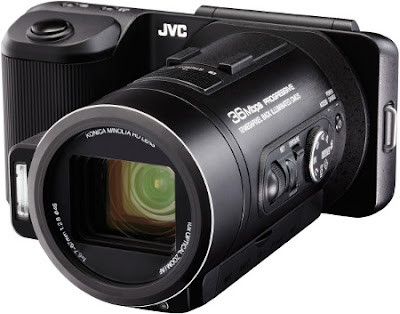
There never was a doubt as to when the digital still camera was going to cross paths with that of the camcorder family, and JVC might have pulled off a masterstroke with their latest model – the JVC GC-PX10. This is a video/still hybrid camera that is touted to deliver professional level performance as well as features, letting you choose between capturing the fleeting moment in 12-megapixel stills, or if you so desire the wonders of Full HD video, then 36Mbps progressive Full HD video and super-slow motion are also options for you.
Apart from that, JVC ensures no matter how much of a beginner you are in photography, you will still be able to capture the perfect moment with 60 shots per second still image shooting, 300 frames-per-second video recording for high-quality super-slow motion as well as the ability to pick out pristine still images from video if the situation calls for something like that – especially when you realized that your photographer has missed out a crucial moment on your Big Day.
Just what makes the JVC GC-PX10 tick? Well, JVC is proud to say that their all new FALCONBRID high speed imaging engine keeps it going, where it was originally spotted over at JVC’s Full HD 3D camcorder, the GS-TD1. For the uninitiated like many of us, FALCONBRID is a single-chip technology that comes with its own processing muscle in order to let the GC-PX10 to record Full HD progressive video at 36Mbps, while capturing 8.3-megapixel during the recording of Full HD video to deliver both high-quality stills from recorded video simultaneously.
There is even an ISO 6400 mode that allows you to capture those precious moments under extremely low light conditions, while rapid-fire still shooting of 8.3-megapixel stills is a possibility as well – just make sure you have the relevant flash memory to be able to support such massive data transfers within a short period of time. Other hardware specifications include optical image stabilization with JVC’s Advanced Image Stabilizer, 10X optical zoom (19x Dynamic Zoom with no image degradation when zoomed), KONICA MINOLTA HD LENS, a mode dial for both automatic and manual settings (white balance, aperture and shutter), microphone output
and headphone input.
The 32GB of internal memory can be further augmented thanks to the inclusion of an SDXC/SDHC memory card slot. The JVC GC-PX10 is not going to come cheap though at $899.95 a pop when it hits the market later this month.
October 3, 2011
Kodak Playfull video camera loves the water
Latest Gadget
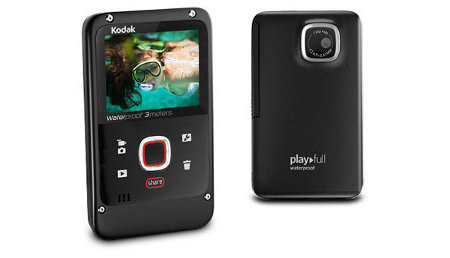
What does a labrador retriever and the Kodak Playfull video camera have in common? Well, they both love the water, although I would say that the labrador is more waterproof in a sense since it can remain in there far longer than the Playfull. We won’t talk about dogs today, but rather, Kodak’s latest version of their video camera which is meant to immortalize your tender and precious moments in a digital format, regardless of how wet it is around you.
The Kodak Playfull video camera is not very large, but comfortably small enough so that it can find its way into to fit easily in a pocket or small purse. While you will not be able to capture precious moments in Full HD quality, at least it offers the bare minimum for today’s standard which is 720p quality videos, but it would have been nicer to see Full HD resolution supported instead in this day and age. Perhaps in the next version, Kodak?
Just because it is waterproof does not mean it is super tough like a Sonim smartphone, so don’t go about abusing it to test the limits of its durability. Waterproof here would mean being able to survive recording underwater without the need for an external case for up to 10 feet, and being dust proof translates to dust bunnies looking at other gadgets to begin their families there. At least it is durable to a certain extent by surviving drops of up to 5-feet on plywood and not concrete, so do be a bit careful if you’re the owner of 10 butterfingers.
Nice to know the LCD display comes with a “Glare Shield” that adjusts its brightness accordingly so that you can view whatever the LCD is showing under direct sunlight, an area that most devices are still struggling with even today. Apart from the regular appearance of integrated effects like sepiatone, black and white, and high saturation among others, you will also find an SDHC memory card slot that is compulsory considering this puppy comes with only 18MB of internal memory. Shame, really, but I guess for $99.95 a pop, there really isn’t much to complain about, is there?
Facebook to check every link for viruses
Facebook will check every web link its users click on for computer viruses and other dangers as part of efforts to improve the security of the world's largest social network.


October 2, 2011
Facebook Timeline: Privacy Settings You'll want to Set
If you care to keep your past in the past, Facebook's new version of the profile, called Timeline, makes that a little more difficult.
 With Timeline, every status update, wall post, and photo ever posted since the day you joined Facebook becomes easily searchable to you and your friends. For many -- early adopters especially -- dredging up the past for all to see can be a privacy nightmare.
When your Facebook account is migrated to the new Timeline -- which Facebook has started rolling out -- you'll have one week to make any adjustments to your past posts and privacy settings before your Timeline will go live for everyone to see. You can publish it yourself anytime within the five-day waiting period.
Here are what your options are for adjusting your settings, based on the level of privacy you want to achieve.
1. How to Make all Posts Friends-Only.
It's possible that your past posts have varied privacy settings based on when they were posted. One way -- the easiest of them all -- is to use one of the blanket privacy settings introduced not long ago: "Limit the Audience for past Posts."
You'll find this option near the bottom of your Privacy Settings page.
If you decide to use this option, content on your timeline that you've shared with more than your friends--such as public posts--will automatically change to Friends only. With this setting, though, people who are tagged and their friends will still be able to see the post.
2. Limit the Posts by Others on your Timeline.
Another way to hide past posts is to limit specific people or lists of people from viewing what others have posted to your wall. To do this, go to your Privacy Settings page, then select "Edit Settings" next to "How You Connect." Select the drop-down menu next to the last item--"Who can see posts by others on your timeline?" and choose "Custom."
In the box under "Hide this from," type the names of the people or the lists that you want to exclude from viewing posts on your wall by others, for example those on your Limited Profile list. Then click Save Changes.
3. Edit Every Post Manually.
I wouldn't recommend this option to anyone -- especially those who have been Facebook users for several years -- because of how time-consuming it could be.
Your timeline lets you search by the year, which breaks down into months. Hover over a story in the timeline to hide a particular one--this means that no one will be able to see it.
While this is a tedious process, it does appear it's the only way to ensure you're hiding exactly what you want from the people you want.
And there's always the "View Profile As" feature, which shows you what others see when they look at your profile.
To find this feature after you've migrated to the new timeline, click the gear icon on the right, below your cover photo, then click "View As..." from the drop-down menu. To preview how your profile appears to the public, click the link in the text, or type a person's name into the field and click enter.
October 1, 2011
How to Find Your IP Address and MAC Address
Figure out the unique address that identifies your PC on the Internet, with this handy
guide.
Billions of computers are linked through the Internet. And with so many devices communicating and exchanging information, each one needs to have a unique identifier so that the right information reaches the right destination.
Much as the Postal Service uses your home address to deliver the correct mail to your mailbox, computers use Internet Protocol (IP) and Media Access Control (MAC) addresses to distinguish between different devices on your network. Finding this information about your computer is simple--and it can be very useful when your machine is on a network. Here’s how to do it.
Using Windows 7
1. Click Start, All Programs, Accessories, Command Prompt.

2. In the prompt that appears, type ipconfig /all and click Return.
3. The prompt will return network information for each network adapter in your computer. Find the section for the adapter that's connected to your network. For example, you can find the network information for your wireless adapter by looking under the 'Ethernet Adapter Wireless Network Connection' section.
4. To find your computer's IP address, look for the 'IPv4 Address' or 'IP Address' entry. This line will display the IP address for your system; typically it looks like a string of numbers separated by periods, such as 192.168.1.1
5. To find your computer's MAC address, look for the 'Physical Address' entry. This line will display your adapter's MAC address, which typically looks like a string of letters and numbers separated by dashes.
Using Mac OS X
1. Click the Apple menu on the upper left part of the screen.
2. Click System Preferences. In the resulting System Preferences menu, select Network.
3. In the Network window, select the network adapter you're interested in. Your IP address will appear in the right-hand pane of the window.
4. To find your MAC address for the adapter, click the Advanced... button. Your MAC address should appear at the bottom of the window.

guide.
Billions of computers are linked through the Internet. And with so many devices communicating and exchanging information, each one needs to have a unique identifier so that the right information reaches the right destination.
Much as the Postal Service uses your home address to deliver the correct mail to your mailbox, computers use Internet Protocol (IP) and Media Access Control (MAC) addresses to distinguish between different devices on your network. Finding this information about your computer is simple--and it can be very useful when your machine is on a network. Here’s how to do it.
Using Windows 7
1. Click Start, All Programs, Accessories, Command Prompt.

2. In the prompt that appears, type ipconfig /all and click Return.
3. The prompt will return network information for each network adapter in your computer. Find the section for the adapter that's connected to your network. For example, you can find the network information for your wireless adapter by looking under the 'Ethernet Adapter Wireless Network Connection' section.
4. To find your computer's IP address, look for the 'IPv4 Address' or 'IP Address' entry. This line will display the IP address for your system; typically it looks like a string of numbers separated by periods, such as 192.168.1.1
5. To find your computer's MAC address, look for the 'Physical Address' entry. This line will display your adapter's MAC address, which typically looks like a string of letters and numbers separated by dashes.
Using Mac OS X
1. Click the Apple menu on the upper left part of the screen.
2. Click System Preferences. In the resulting System Preferences menu, select Network.
3. In the Network window, select the network adapter you're interested in. Your IP address will appear in the right-hand pane of the window.

September 30, 2011
Two More Ways To Hack Facebook’s Timeline Cover

Even if they are all recylcled, it’s still pretty cool considering only one week has elapsed since Facebook made the new timeline profile available to those who have the Developer application installed on their profiles.
We’ve previously covered three such tools: Coverize.me, Facebook Timeline Cover Creator and Facebook Covers. Today we discovered two more of them.

Like the other tools in this space, all of these covers have Fresh Facebook Covers’ web address stamped in the lower right-hand corner — do you want that in your profile?
On Fresh Facebook Covers, the button “download this cover” appearing beneath all of the images makes it look like you’ll automatically capture the image, but clicking on it simply opens up a larger version of the graphic a new tab. You have to save it yourself and then upload it on your own to your timeline.

These groups are labeled: abstract, animals, awareness, awesome, cute, funny, hearts, life, love, movies, music, people, quotes, sports, TV shows and video games.
To the right of each image on FacebookCovers.org there’s a button labeled “add to profile.”
Clicking on the link fires up a permission window asking your permission for access to your profile, but all that does is upload the chosen graphic to your photo albums. You still have to click on “change cover.”
Also, like the others we’ve covered (pun intended if you want), all of the images available on FacebookCovers.org bear the site’s brand name in the lower-right-hand corner.
It’s easy to erase that branding in any graphics editor, although it would be impolite of us to recommend that practice.
So, dear readers, have you tried out any of the applications for tricking out your cover image in Facebook’s timeline?
Apple's iPhone Event is Near: 5 Predictions

Apple will put an end to the rumors and introduce its next iPhone on October 4--it's already sent out invitations to an iPhone-specific event that will be held at Apple's Cupertino campus. New Apple CEO Tim Cook is expected to take the stage and make the big announcement.
This means we've got just one more week for some good, old-fashioned speculation. Here's what I think we'll see at Apple's upcoming iPhone event:
Prediction #1: The New iPhone Will Look
Different
Depending on which story you're reading, the next iPhone will either have a completely new design or be
exactly the same, aesthetically, as the iPhone 4.

Prediction #2: Hardware Will be New, but Predictable
The iPhone 4 had a new design, but it didn't surprise us with its specs--it received the same A4 chip as the iPad. Following the same lines, I think the next iPhone will have the same dual-core A5 chip that debuted in the iPad 2.
I think we can probably look forward to a new camera--not only do rumors suggest that the next iPhone will have an 8MP camera, but Apple has a history of improving the iPhone's camera with each generation. To go with the new chip and camera, the next iPhone will also probably have 1GB of RAM--but Apple probably won't say much about this. After all, Apple doesn't usually spend a lot of time discussing specs.
Prediction #3: Hardware Isn't Everything
Rumor has it that the next iPhone will have software improvements, including expanded voice commands. The new voice commands--part of a feature reportedly called Assistant--are based on Siri, the virtual assistant software maker that Apple acquired last year.
This system-wide voice navigation system could be a standout feature that's exclusive to the iPhone 5, and a big focus at next Tuesday's event. Apple did make voice commands exclusive to the iPhone 3GS in 2009, so requiring an iPhone 5 for expanded voice commands isn't without precedent.
Bonus prediction: The event invitation includes a photo of the iPhone's maps application icon, which has me wondering if Apple will finally add turn-by-turn directions.

Prediction #4: A Cheaper iPhone
The use of the singular in the invitation ("Let's talk iPhone") has led pundits such as John Gruber to speculate that Apple will only launch one new iPhone, despite rumors to the contrary.
While Apple may not launch an iPhone 4S, it will still drop the price on its old iPhones--AT&T and Verizon iPhone 4's--as it has in the past. Low-cost, older-generation iPhones have proven to be very successful, and are one of the reasons AT&T far outpaced Verizon in sales in the second quarter, despite Verizon having the iPhone 4. I doubt Apple will give up that market.
Prediction #5: Sprint Gets Love

T-Mobile, on the other hand, probably won't be part of Apple's announcement. When asked if T-Mobile would be getting the next iPhone, T-Mobile CEO Cole Brodman recently said, "To my knowledge, not in October."
Subscribe to:
Posts (Atom)
